Immigration to Canada from India is one of the busiest paths into this country. India is one of the largest source countries for newcomers, so there is a lot of advice out there. Some of it is good. A lot of it is old, loud, or wrong.
I have spent about ten years in Canada’s settlement sector, and more than eight of them leading a team in Regina. I also came to Canada myself at 13, and my family moved through five cities before we settled. So I know both sides: the paperwork and the feeling of starting over.
Here is the plain version. I wrote it so you can read it once and know what to do next. Let’s get into it!
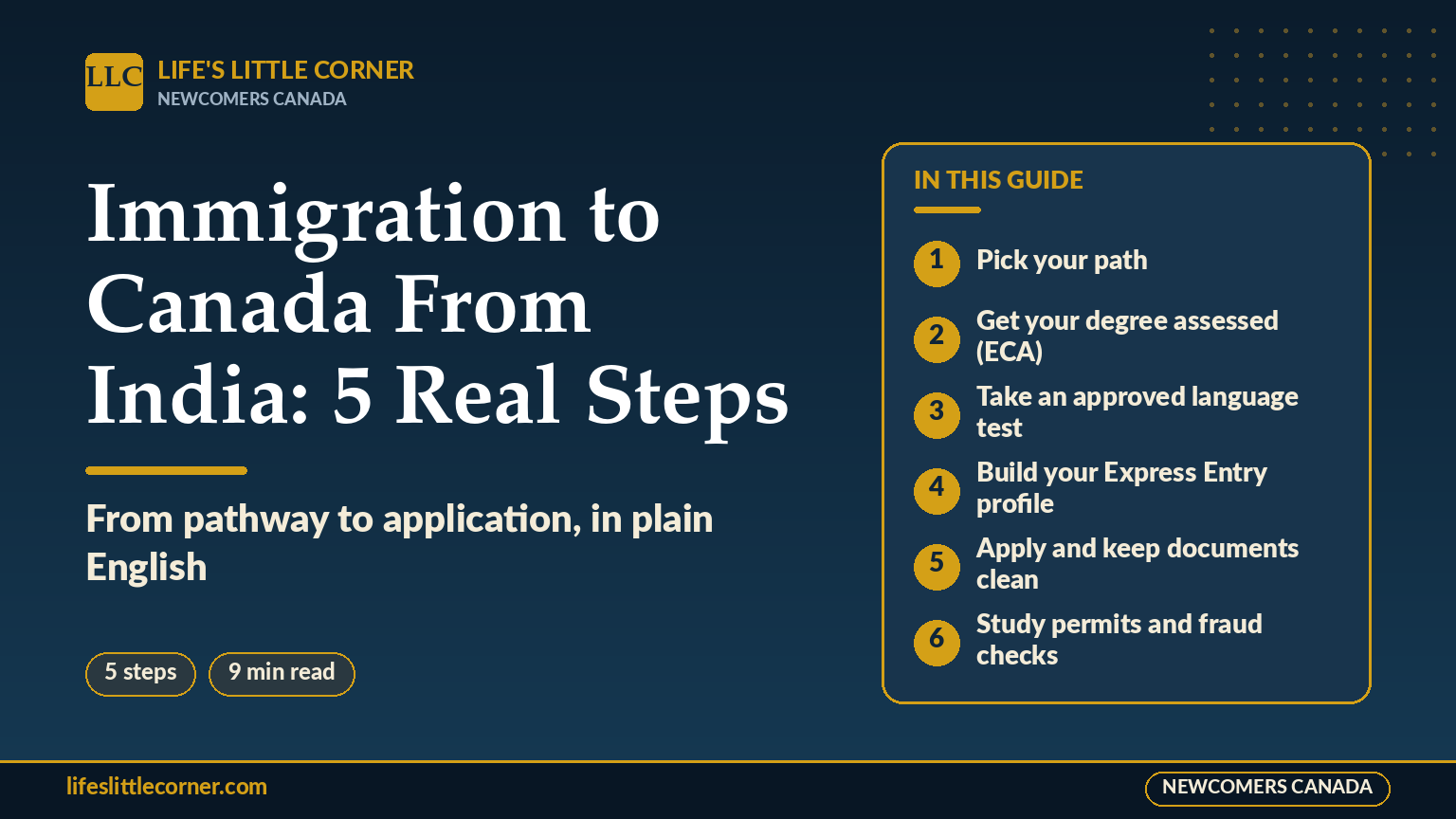
Step 1: Pick Your Path for Immigration to Canada From India
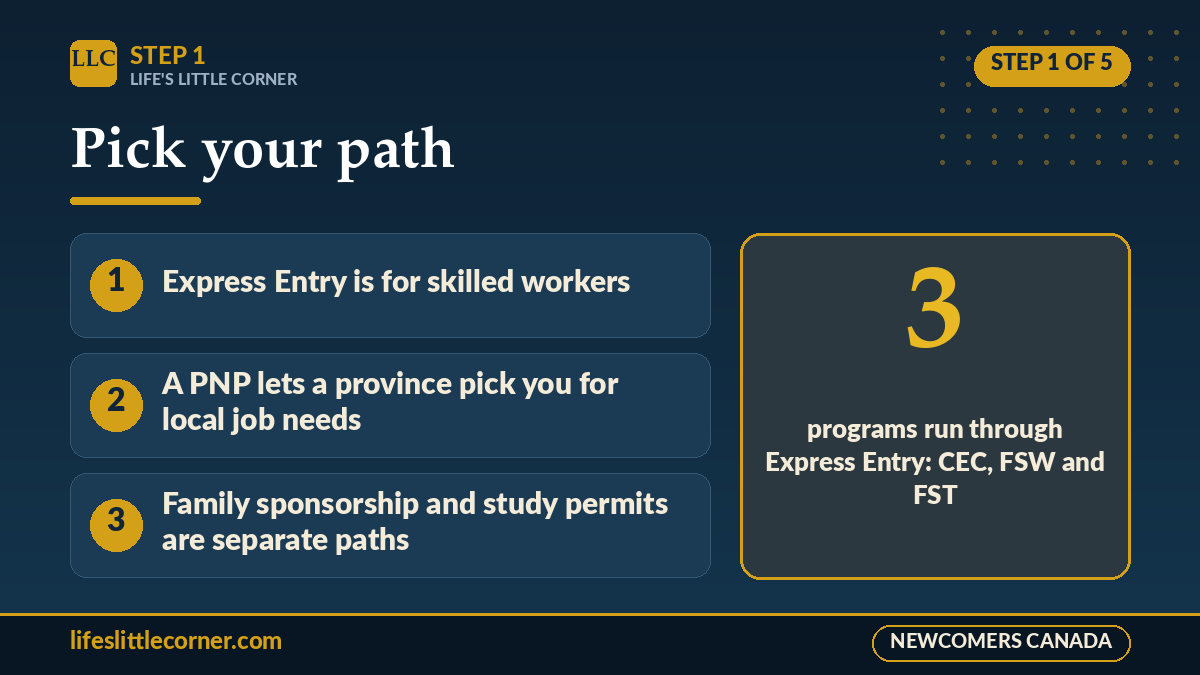
There are four main paths: Express Entry, a Provincial Nominee Program, family sponsorship, and a study or work permit that may lead to permanent residence later. Most skilled workers start with Express Entry.
Express Entry is an online system that Immigration, Refugees and Citizenship Canada (IRCC) uses to manage applications from skilled workers. It runs three programs: the Canadian Experience Class, the Federal Skilled Worker Program, and the Federal Skilled Trades Program. IRCC explains each one on its Express Entry page.
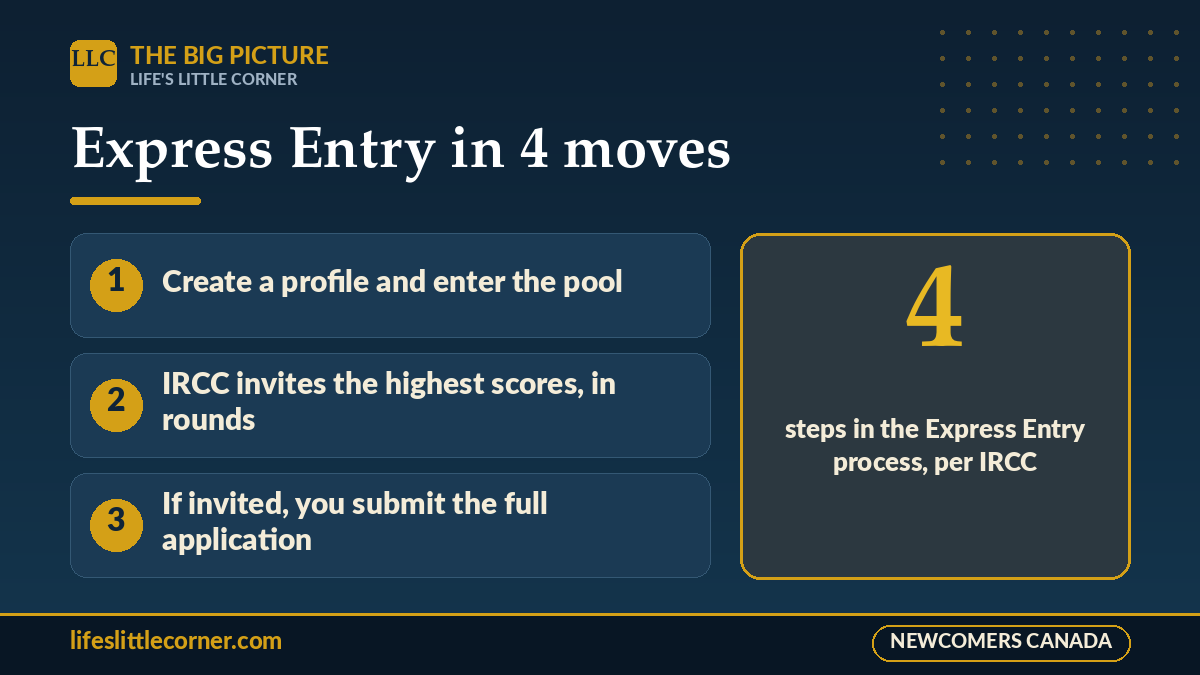
The process is the same for every country. You create a profile. IRCC invites the people with the most points, in rounds. If you get an invitation, you fill out the full application. Then IRCC reviews it and makes a decision.
A Provincial Nominee Program, or PNP, lets a province pick people who match its job needs. Family sponsorship is for people with a close relative in Canada. Both have their own rules, so check each one before you pick.
What is different about immigration to Canada from India? Not the rules. IRCC applies the same program rules to everyone. The difference is the volume. Many people apply from India, so clean documents matter, and so does extra time for the steps that depend on other offices, such as your university sending records.
Not sure which path fits you? Start with our guide to the real checklist of Canada immigration requirements. Then come back here for the India-specific parts.
One honest warning. IRCC changed some Express Entry rules this year. Its “What has changed” page was updated in October and covers points for Canadian work experience and job offers. I will not quote point numbers here, because they can move. Read that page the week you apply.
Step 2: Get Your Indian Degree Assessed (ECA)
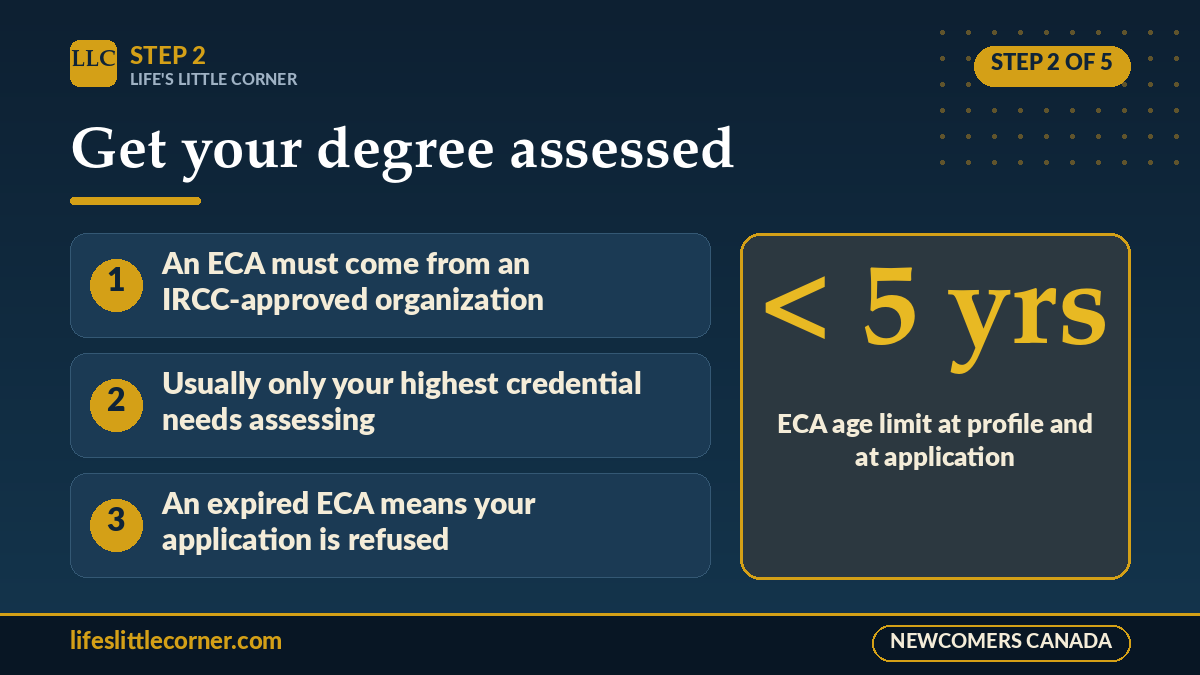
An Educational Credential Assessment, or ECA, checks that your Indian degree or diploma is equal to a Canadian one. If you studied outside Canada, you need one to qualify as a Federal Skilled Worker or to earn points for that education.
The report must come from an organization that IRCC has approved. The list includes World Education Services (WES), the International Credential Assessment Service of Canada (ICAS), the Comparative Education Service at the University of Toronto, IQAS in Alberta, and BCIT in British Columbia. Doctors, pharmacists, and architects must use a professional body instead. IRCC lists them all on its educational credential assessment page.
Start early. Each organization sets its own costs and wait times. They also ask for documents sent straight from your university. That step can take longer than people expect, so do not leave it for last.
In most cases you only need to assess your highest level of education. If you have a master’s degree, you do not also need to assess your bachelor’s degree. If you want points for more than one credential, each one needs its own assessment.
Your ECA must be less than five years old on two dates: when you finish your profile, and when you submit your application. If it expires before you apply, IRCC will refuse the application. Plan around that date.
An ECA does not guarantee a job. It also does not give you a licence in a regulated profession, such as nursing or engineering. Those licences come from the province where you plan to live. Our guide on getting foreign credentials recognized in Canada explains that second step.
Step 3: Take an Approved Language Test
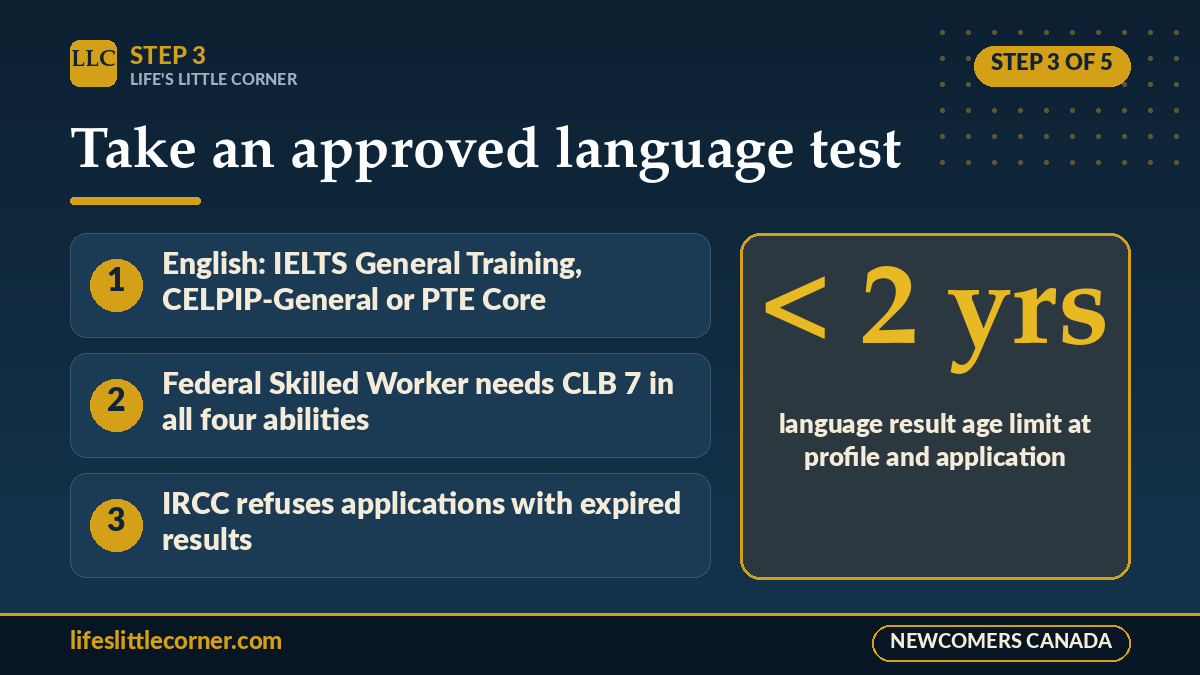
You must prove your English or French with an approved test. For English, IRCC accepts the CELPIP-General, the IELTS General Training, and the PTE Core. For French, it accepts the TEF Canada and the TCF Canada.
Pick the right version. For IELTS you need the General Training test, not Academic. IRCC also does not accept the IELTS One Skill Retake for Express Entry. Many people book the wrong test and lose time and money.
Your results are measured on the Canadian Language Benchmarks, or CLB. For the Federal Skilled Worker Program, the minimum is CLB 7 in all four abilities: speaking, listening, reading, and writing. For the Canadian Experience Class, the minimum depends on the job. Higher-skilled jobs (TEER 0 or 1) need CLB 7. Other jobs (TEER 2 or 3) need CLB 5. The full tables are on IRCC’s language test results page.
Time your test with care. Results must be less than two years old when you complete your profile and when you apply. If they expire first, IRCC will refuse the application. Book early enough that you can retake the test if you need to.
Get the free First 30 Days in Canada Checklist
Once you land, know exactly what to do first. It comes from someone who helps newcomers every day.
Step 4: Build Your Express Entry Profile
Create your profile only after your ECA and language results are in hand. The profile asks for your age, education, work history, language scores, and family details. IRCC uses it to give you a score.
That score is how you are ranked. IRCC invites the highest-scoring people in rounds, so you may wait. Some people enter the pool and are invited quickly. Others wait months. Nobody can promise you a date, and that includes agents.
Be exact when you fill out the profile. The dates, job titles, and scores must match your documents. A small mismatch can cause delays later, or worse, a refusal.
Use IRCC’s own score tool to see where you stand. Then ask honestly whether you can raise your score. A stronger language result is often the fastest way. Our guide to what happens after you apply to Express Entry covers the stage that comes next.
Step 5: Apply, and Keep Your Documents Clean
If you get an invitation, you have a limited time to submit your full application. Gather your passport, police certificates, proof of funds, ECA report, and language results before the invitation arrives. Then you are not rushing.
Check every date. Your ECA and language results must still be valid on the day you submit. If either one will expire, retest or reissue first, or you risk a refusal.
Upload clear, complete copies. Answer every question truthfully. IRCC treats lies and false documents very seriously, and the consequences can last for years.
Keep a simple folder, on paper and on your phone, with every document you submit. Add the date you sent it and any reference numbers. If IRCC writes to you months later, you will know exactly what you sent.
After you apply, IRCC may ask for biometrics and a medical exam. Follow each request on time. Most delays in immigration to Canada from India, and from every other country, start with a missed request or an expired document.
For a step-by-step view of the whole journey, read how to apply for Canada immigration in six steps.
Thinking About a Study Permit? Read This First
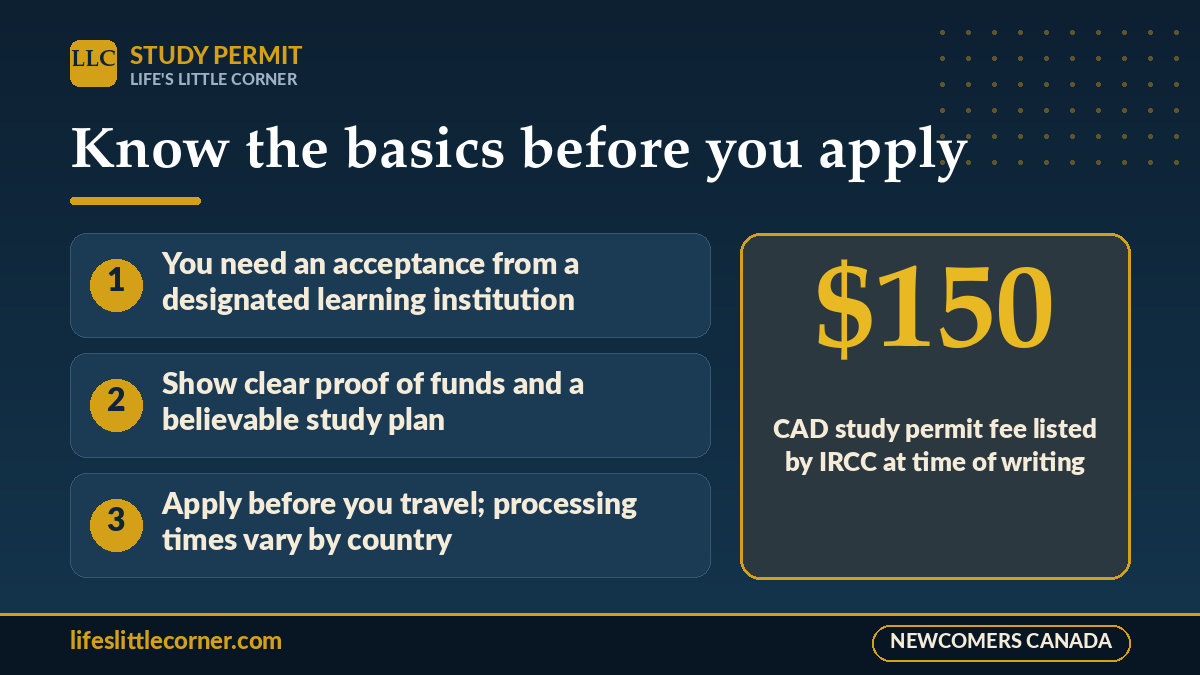
A study permit lets you study at a designated learning institution (DLI) in Canada. IRCC lists the fee at $150 at the time of writing, and you should apply before you travel. Processing times vary by country, so check the live times for India.
A study permit is not a shortcut to permanent residence. It is a temporary permit with conditions. Some students later qualify for work permits and then for Express Entry, but that is a separate path with its own rules.
It is also fair to say that study permit applications from India have drawn extra attention in recent years. Canadian news outlets and immigration professionals have reported higher refusal rates. I am not quoting a percentage, because I could not confirm one from an IRCC source. The lesson is simple: make your application complete and consistent.
That means a real acceptance letter from a school on the DLI list, clear proof of funds, and a believable study plan. IRCC’s study permit page lists the requirements. Work directly with the school and read every line before you sign.
How to Avoid Fraud on Your Way to Canada
Scammers target people who are hopeful and in a hurry. IRCC runs a whole section on immigration fraud and scams. Read it before you pay anyone.
If you use a paid representative, they must be authorized. That means a licensed immigration consultant, a lawyer, or a Quebec notary. IRCC has a page where you can check. Never pay someone who guarantees a visa or a job offer. No honest agent can promise that.
Check your school too. IRCC publishes a list of designated learning institutions. If a school is not on it, a study permit for that school will not work. Do the same checks for any job offer, and keep copies of everything you send.
Once you arrive, scams change shape. They target newcomers with fake government calls, fake landlords, and fake job offers. I wrote a separate guide on how to protect yourself from scams in Canada. It is worth reading before you land.
What to Do This Week
You do not need to do everything at once. Pick the next small step and finish it.
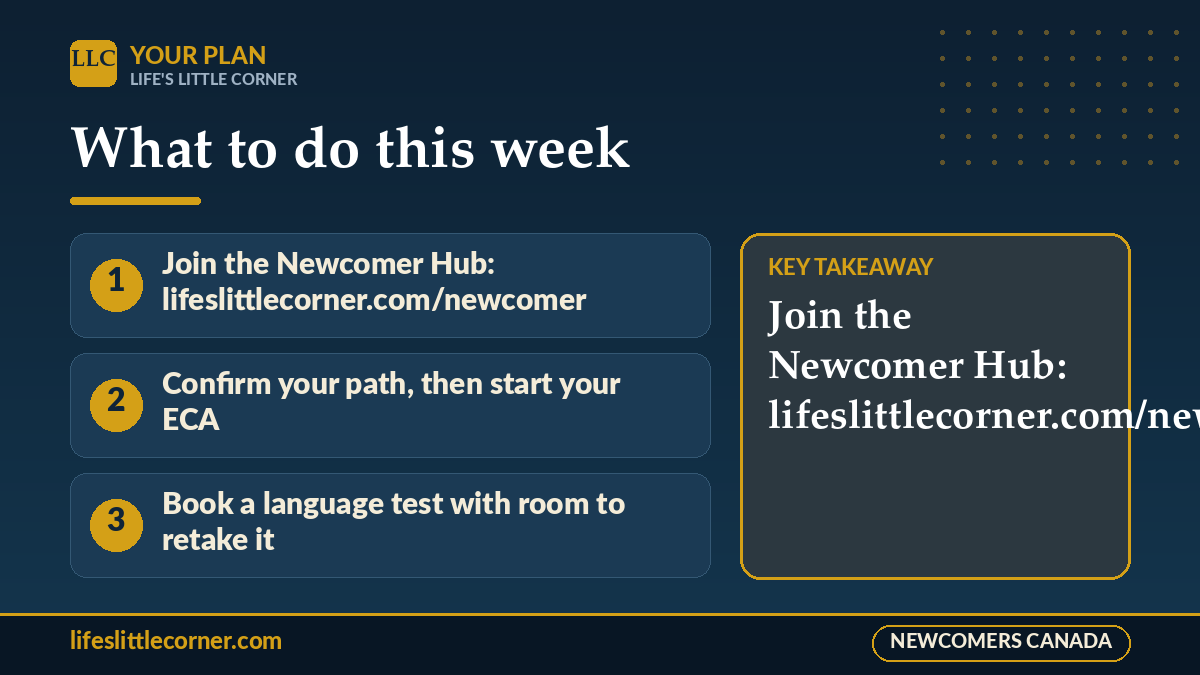
First, confirm your path using the requirements checklist. Second, choose an approved organization and start your ECA. Third, book a language test with room to retake it. Fourth, build your profile. Fifth, keep every date in a simple list, so no document expires by surprise.
Plan for the landing too. Your first days in Canada are busy, and the order matters. Our guide to the first 72 hours in Canada walks through it.
Free: First 30 Days in Canada Checklist
Get the exact order of what to do after you land, from a settlement-sector team leader.
This is general information, not legal or immigration advice. Rules change, so always confirm the details on IRCC’s own pages before you act.
You did something hard to get this far. Canada is worth the effort. You just need the map.