
.llc-post{max-width:760px;margin:0 auto;color:#1c3a4f;font-size:19px;line-height:1.75;font-family:Georgia,serif}
.llc-post h1{font-size:38px;line-height:1.15;color:#0F2438;margin:0 0 14px}
.llc-post h2{font-size:27px;color:#0F2438;margin:44px 0 8px}
.llc-post p{margin:0 0 18px}
.llc-post img{width:100%;height:auto;border-radius:10px;margin:22px 0 6px;box-shadow:0 8px 28px rgba(15,36,56,.16)}
.llc-post figcaption{font-size:14px;color:#6b7c8c;margin:0 0 20px;font-family:system-ui,Arial,sans-serif}
.llc-post a{color:#1d6fa5}
.llc-post .toc{background:#f3f6f9;border:1px solid #dce6ee;border-radius:12px;padding:20px 26px;margin:28px 0;font-family:system-ui,Arial,sans-serif;font-size:17px}
.llc-post .toc strong{display:block;color:#0F2438;font-size:15px;letter-spacing:.04em;text-transform:uppercase;margin-bottom:10px}
.llc-post .toc ol{margin:0;padding-left:20px}.llc-post .toc li{margin:6px 0}
.llc-post blockquote{border-left:4px solid #D4A017;margin:24px 0;padding:6px 0 6px 20px;color:#1d4e6f;font-style:italic}
.llc-post .video{position:relative;border-radius:12px;overflow:hidden;margin:24px 0 6px;background:#0F2438;aspect-ratio:16/9;display:flex;align-items:center;justify-content:center;text-align:center}
.llc-post .video a{color:#fff;text-decoration:none;font-family:system-ui,Arial,sans-serif}
.llc-post .video .play{width:74px;height:74px;border-radius:50%;background:#D4A017;display:flex;align-items:center;justify-content:center;margin:0 auto 14px}
.llc-post .video .play span{border-left:24px solid #0F2438;border-top:15px solid transparent;border-bottom:15px solid transparent;margin-left:6px}
.llc-post .cta{background:#0F2438;color:#fff;border-radius:12px;padding:26px 28px;margin:34px 0;font-family:system-ui,Arial,sans-serif}
.llc-post .cta h3{margin:0 0 8px;color:#fff;font-size:22px}.llc-post .cta p{color:#cfe0ef;font-size:16px;margin:0 0 16px}
.llc-post .cta a{display:inline-block;background:#D4A017;color:#0F2438;font-weight:700;text-decoration:none;padding:12px 26px;border-radius:8px}
.llc-post .kit-box{background:#f3f6f9;border:1px solid #dce6ee;border-radius:12px;padding:18px 22px;margin:28px 0;font-family:system-ui,Arial,sans-serif}
Where Leaders Should Start With AI: 5 Real Moves
Here is a surprising number. Gallup’s workforce tracking shows employee engagement has stayed flat even as AI use has climbed fast across the workforce. More AI, on its own, has not made teams more engaged. That is the clearest sign yet that where leaders should start with AI matters more than how much of it they roll out.
Here is why the starting point decides so much. Gallup’s people-first research on AI adoption found that employees whose manager actively supports their AI use are 1.7 times more likely to use AI every week, and 7.4 times more likely to say AI helps them do their best work. The manager, not the tool, is what makes adoption stick.
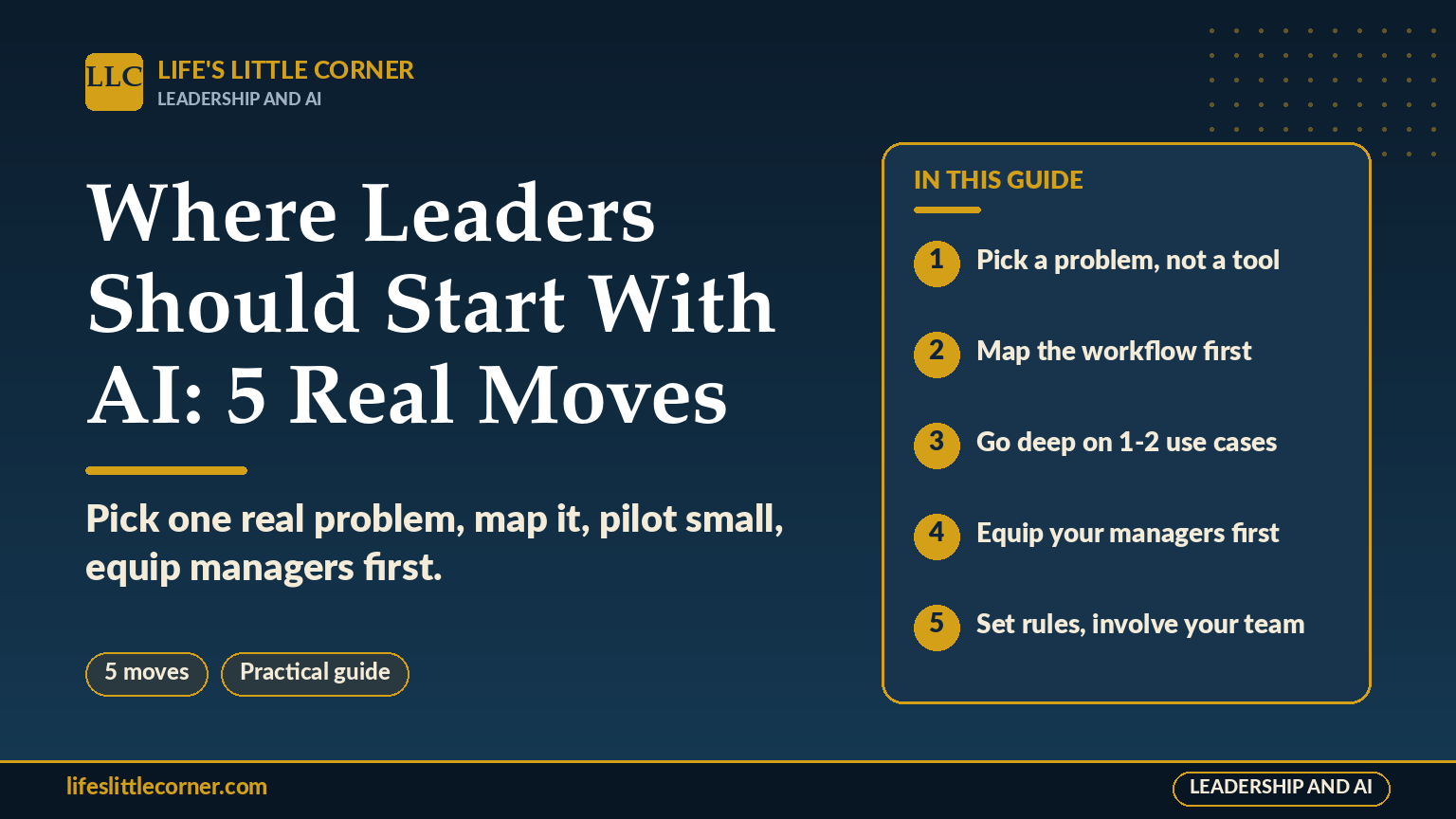
I have broken this down into five moves, in the order I would actually take them. None of them need a big budget or a technical team. Let’s get into it!
Where Leaders Should Start With AI: Pick a Problem, Not a Tool
Most leaders start the wrong way. They see a demo, get excited, and ask a question that is too big: “where could we use this?” That question leads to a dozen scattered experiments and very little real progress.
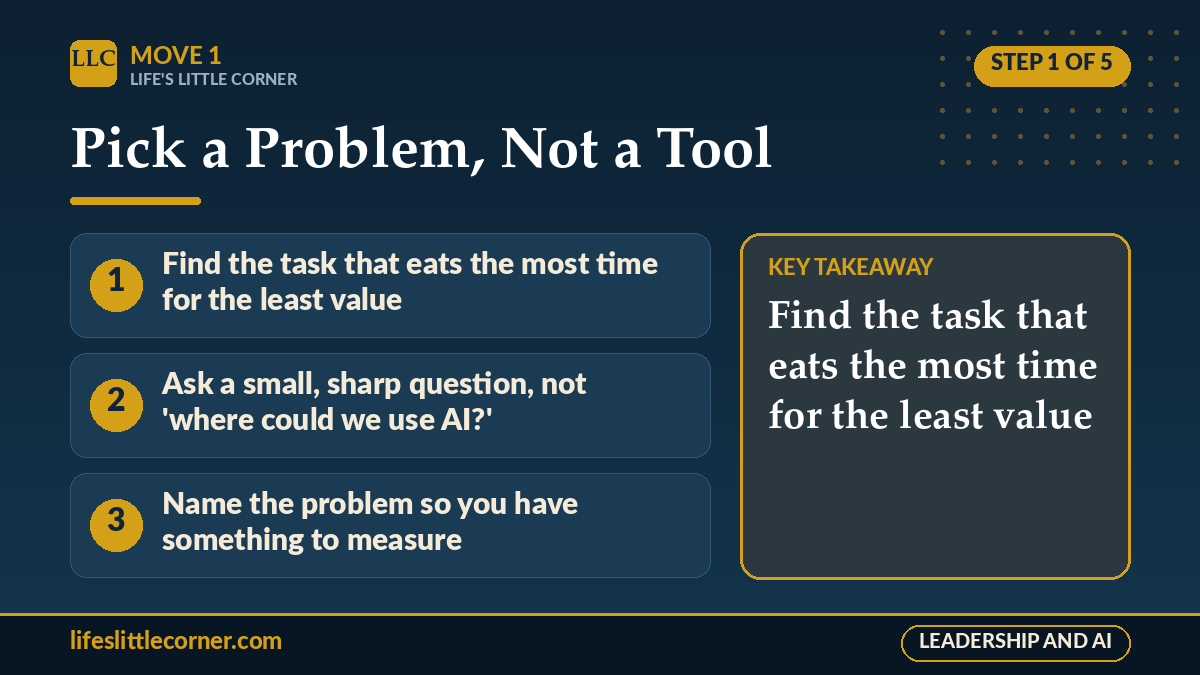
A better question is smaller and sharper. What is the one task that eats the most time, or causes the most frustration, for the least value? Maybe it is the weekly report nobody enjoys writing. Maybe it is answering the same five customer questions every single day. Maybe it is digging through old emails to find one number.
Gallup’s own advice to leaders here is blunt: stop asking where AI could help in general, and instead sit with the real work in front of a team, break one workflow into its steps, and find the small jobs AI can already do well. That is a task-level approach, not a tool-level one, and it is the real difference between AI that gets used and AI that gets ignored.
Naming the real problem does two things for you. First, you get something to measure. You already know how long the old way takes, so you will know fast whether the new way actually helps. Second, you avoid buying a tool your team quietly abandons after week two. I have watched this mistake happen up close — AI Implementation Gone Wrong walks through exactly how it plays out when a leader picks the tool before the problem.
Pick the problem first. Let the tool follow. It sounds obvious, and it is still the step most leaders skip.
Map the Workflow Before You Automate Anything
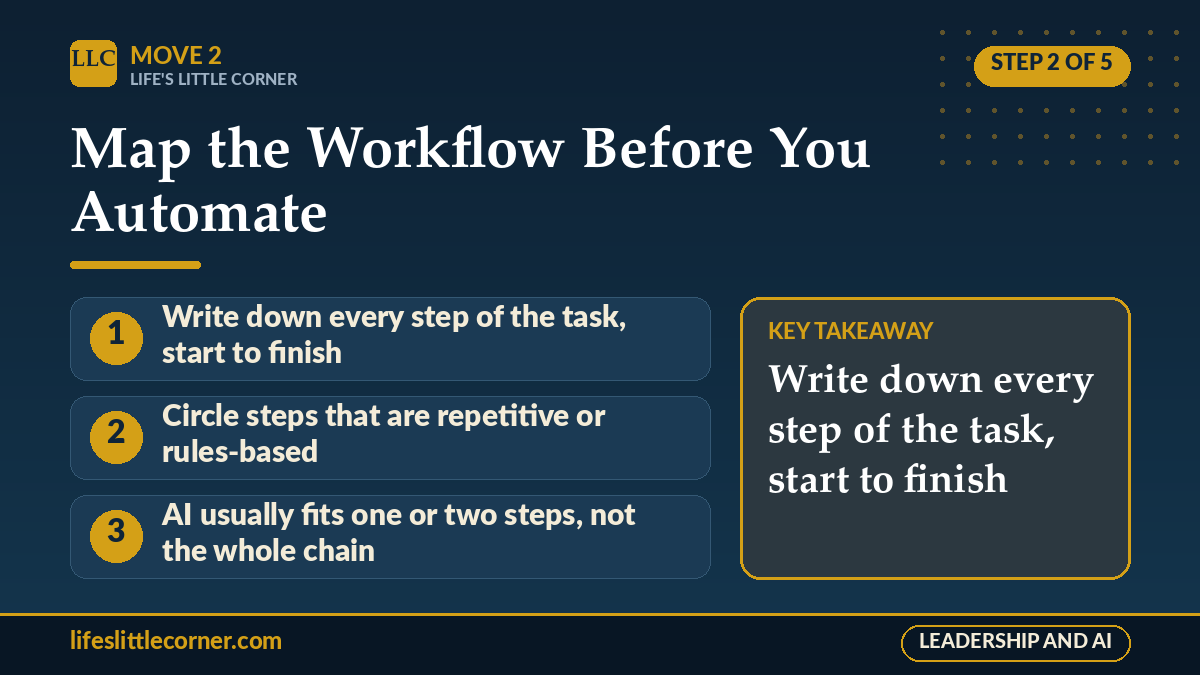
Once you have a real problem, do not jump straight to automating it. Map the workflow first. Write down every step someone takes to do the task today, from start to finish. It feels slow. It saves you from a bad decision later.
Most tasks are not one single job. They are a chain of five or six small jobs stitched together. A weekly report might include pulling numbers from three systems, writing a summary, formatting a slide, and emailing it out. AI might be a great fit for the summary and a poor fit for pulling numbers out of a system it cannot access.
This is where a lot of AI projects quietly fail. A leader hears “AI can write reports” and assumes the whole task disappears. In reality, AI is usually strong at one or two steps in a longer chain, not the entire chain. Mapping the steps shows you exactly which ones those are.
Grab a notepad, or open a blank document, and just watch someone do the task, or do it yourself once. Number every step. Circle the ones that are repetitive, rules-based, or built from patterns in text and data. Those circled steps are your best early candidates. The rest stays human for now, and that is completely fine.
Here is a concrete example. Say the task is answering customer emails about order status. Step one is reading the email. Step two is looking up the order in a separate system. Step three is writing a reply in the company’s tone. Step four is sending it and logging the interaction. AI is usually a strong fit for step three, a weak fit for step two unless it is connected to that system, and not needed at all for steps one and four. Without the map, a leader might buy a tool that promises to “handle customer email” and then feel let down when it only really nails one of the four steps.
Pick One or Two Use Cases and Go Deep
Now comes the hardest discipline: stop at one or two use cases. It is tempting to roll AI out everywhere at once, especially once you see it work in one spot. Resist that.
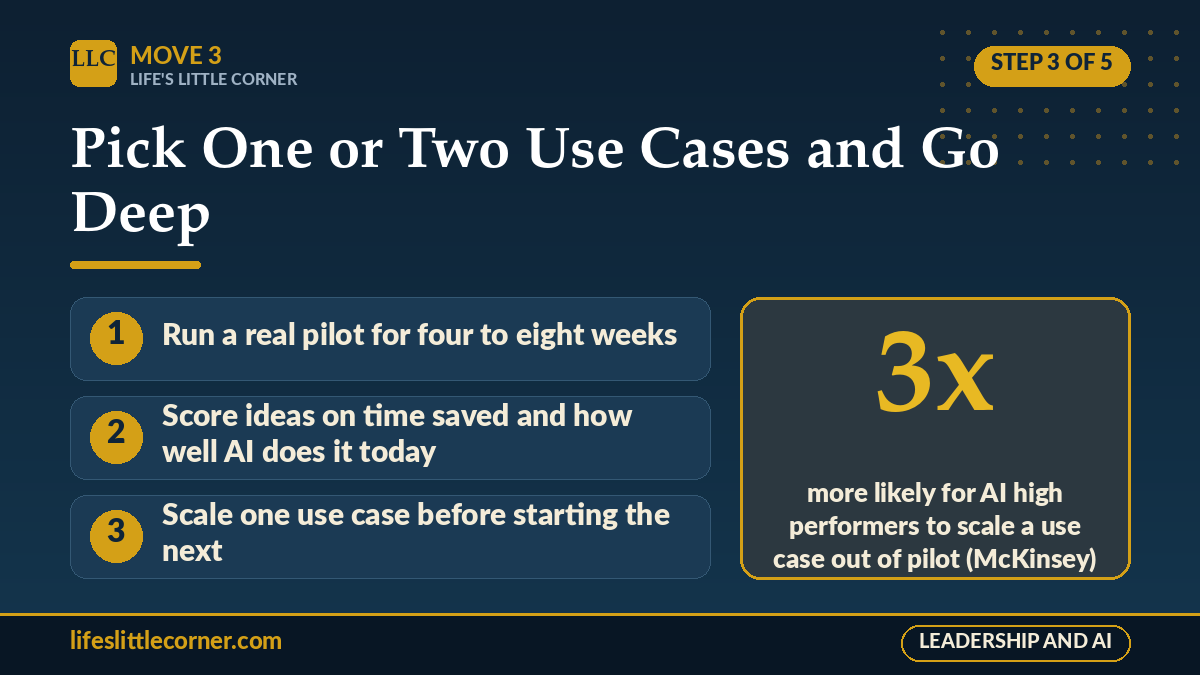
McKinsey’s 2025 State of AI report found that the organizations getting real value concentrate on their two or three highest-impact use cases and commit real resources to them, instead of spreading thin across dozens of small experiments. The same report found that AI “high performers” are three times more likely than everyone else to move a use case out of pilot and into everyday, scaled use.
That scaling gap is the real risk. A November 2025 Harvard Business Review piece, “Stop Running So Many AI Pilots”, warns about what it calls pilot purgatory: a company running many small AI trials that each save a little time, but none of them ever turn into lasting change. Busy, but not actually moving forward.
If more than one problem from your workflow map looks promising, do not try to rank them by gut feeling. Score each one on two things: how much time or money it could realistically save, and how confident you are that AI can actually do it well today. A task that saves a little time but AI handles almost perfectly beats a task that could save a lot of time but AI only half-handles. The half-handled one is where pilots quietly stall and erode trust in the whole effort.
Want more leadership + AI guides like this?
Get notified when Murshed’s upcoming Leadership book launches, plus practical posts on adopting AI responsibly.
Here is the practical version. Pick your one mapped problem from the last step. Run it as a real pilot, with a real team, for four to eight weeks. Measure it against the old way. Only once it is working, and people actually want to keep using it, do you look for the next use case. Depth beats width, every time, early on.
Equip Your Managers Before You Equip Everyone Else
This is the step almost everyone skips, and it is the one the data says matters most. Before you train your whole company, invest in your managers.
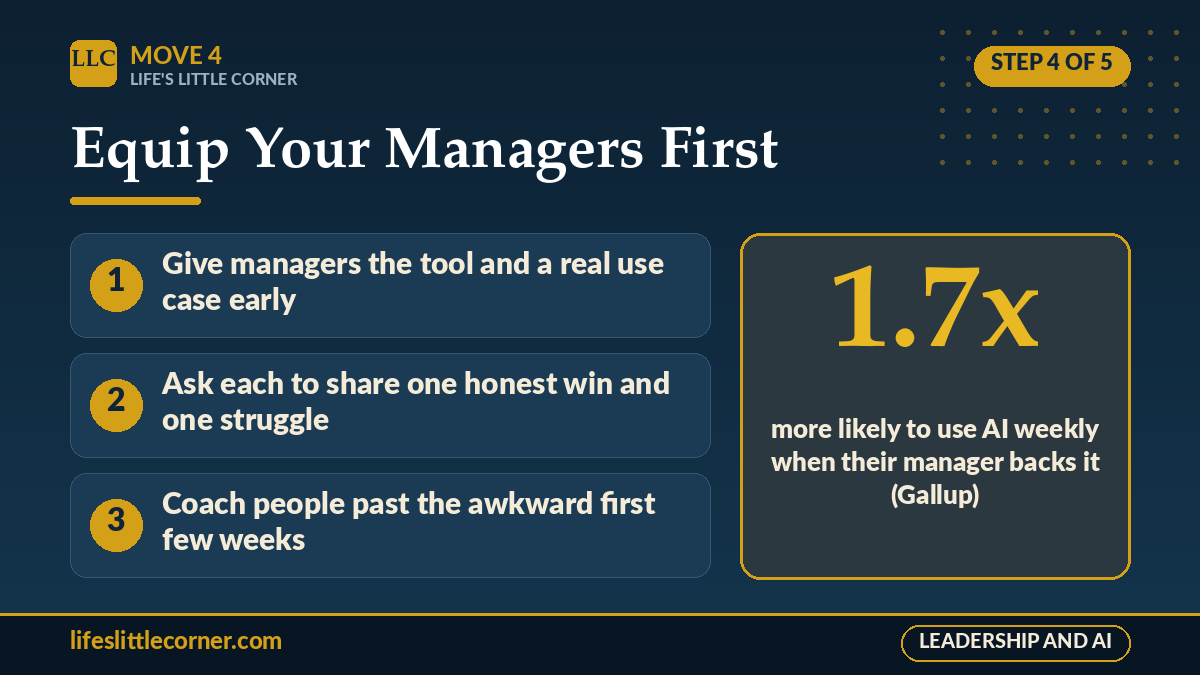
Gallup’s research is specific here. Employees whose manager actively supports their team’s AI use are 1.7 times more likely to use AI a few times a week or more. They are 7.4 times more likely to strongly agree that AI gives them more chances to do their best work. That is a massive gap, and it comes down to one person: the direct manager.
Think about why that makes sense. A manager sets the tone every single day. If a manager rolls their eyes at AI, or never mentions it, their team quietly drops it too, no matter what the company-wide memo said. If a manager tries it themselves, talks openly about what worked, and coaches people through the awkward early stage, adoption follows naturally.
Practically, this means your first real training budget should go to your managers and team leads, not a company-wide webinar. Give them the tool early. Give them a real use case to try on their own work — 10 Game-Changing AI Prompts That Save Leaders 15+ Hours a Week is a good starting list if they are not sure where to begin. Then ask each manager to share one honest win and one honest struggle with their team. That is worth more than any slide deck.
Two teams can get the exact same AI tool and the exact same training, and still end up in completely different places six months later. The variable is not the software. It is whether the manager kept talking about it, kept using it visibly, and kept coaching people past the awkward first few weeks, or went quiet after the kickoff meeting and let the tool quietly fade into an unused login. That is the whole case for spending your first real effort on managers, not on a company-wide rollout.
Set Basic Rules and Involve Your Team Early
Before this spreads past your pilot team, put a few basic rules in writing. You do not need a fifty-page policy. You need clear, short answers to a handful of real questions.
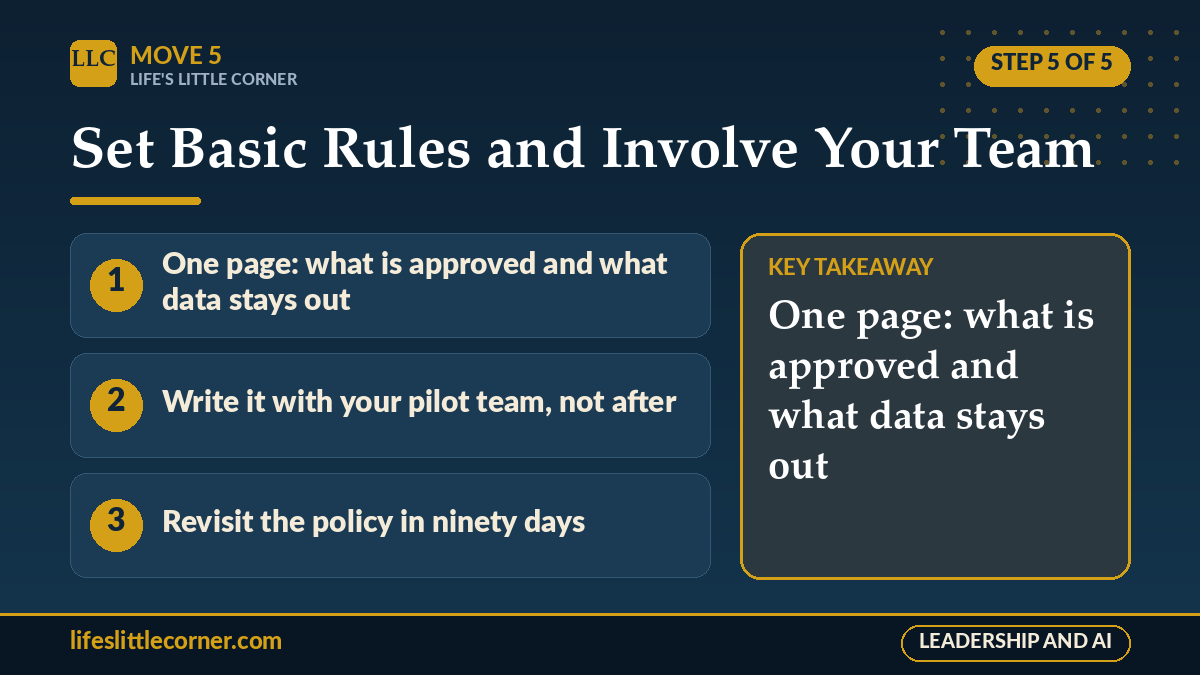
What is approved for use, and what is not yet? What kind of company or customer data should never be typed into an outside AI tool? Who does someone ask if they are not sure? A short written answer to each question, one page is plenty, removes the guesswork that makes people either avoid AI completely or use it recklessly.
Involve your team while you write it, not after. McKinsey’s same report found that at AI high performers, senior leaders are three times more likely to visibly own and champion AI adoption themselves, rather than delegating it down and hoping it catches on. Ownership from the top, paired with real input from the people doing the work, is what actually builds trust.
This does not need to slow you down. A short conversation with your pilot team about what felt useful, what felt risky, and what confused them gives you almost everything you need for that one-page policy. If you want the human side of this step, Emotional Intelligence in Leadership covers how to read a team’s real reaction, not just their polite one.
Put a date on your calendar to revisit the policy in ninety days. Rules written before anyone has really used the tool are always a little wrong. Maybe the data boundary was too strict and slowed people down for no reason. Maybe a use case you banned turns out to be genuinely safe once you understand it better. Treat the one-page policy as a living document, not a plaque on the wall, and say so out loud when you first share it. People trust rules more when they know the rules are allowed to improve.
Want more posts like this one? Join the leadership list below and get notified as new guides go up.
Where leaders should start with AI comes down to five moves: pick a real problem, map the workflow, go deep on one or two use cases, equip your managers first, and set a few clear rules while you involve your team. None of that requires a big budget or a technical background. It requires patience, and a willingness to start small on purpose.
Start this week. Pick one problem, watch how your team actually does it today, and take the first honest step from there.