Best Leadership Style: Why No Single Approach Wins
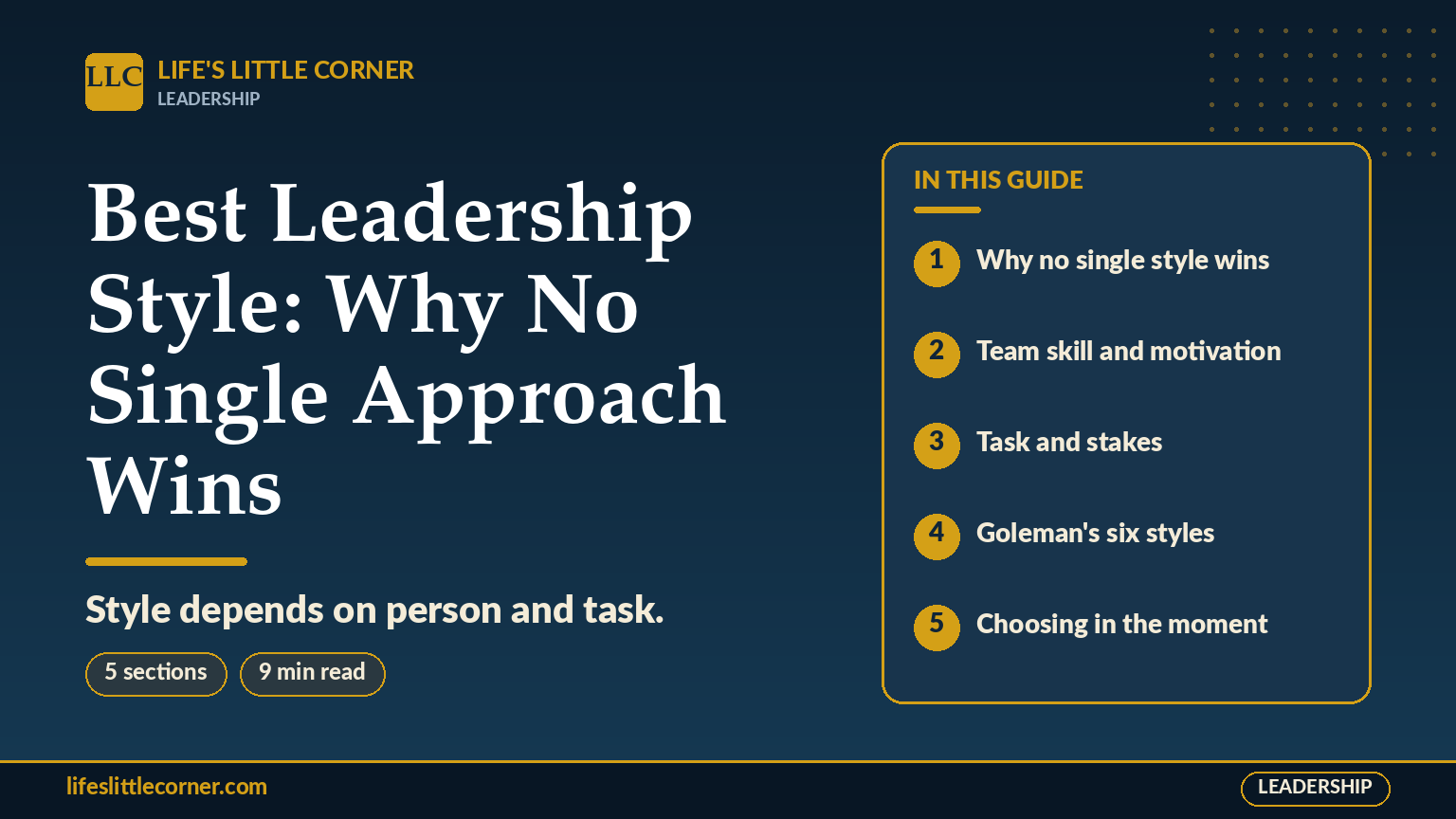
Researchers have been studying this question since the 1960s, and the answer keeps coming back the same way: there is no single best leadership style. Paul Hersey and Ken Blanchard built an entire framework, situational leadership, around that one finding, and it has held up for more than fifty years.
I used to think the best leaders had one signature style they used everywhere, all the time. That is backwards. The best leadership style changes depending on who you are leading, what the task actually needs, and how much time you have.
This post walks through what actually decides the right style in a given moment, and how to make that call quickly instead of guessing. Let’s get into it!
Why There Is No Single Best Leadership Style
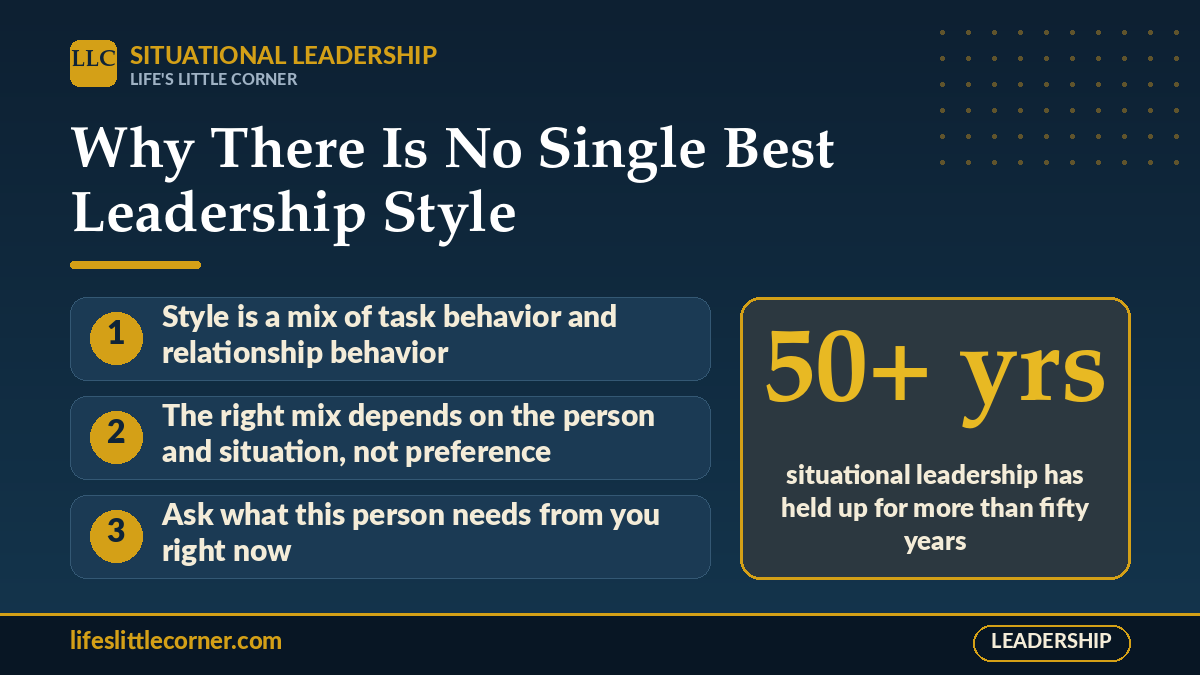
The best leadership style is whichever one fits the specific person, task, and moment in front of you right now. That is the entire idea behind situational leadership theory, developed by Paul Hersey and Ken Blanchard. It is one of several contingency theories of leadership, all built on the same basic claim: leadership effectiveness depends on the situation, not on one leader’s fixed personality.
Hersey and Blanchard broke leader behavior into two simple dimensions. The first is task behavior: how much direction, structure, and step-by-step instruction a leader gives. The second is relationship behavior: how much support, encouragement, and two-way conversation a leader offers. Every leadership style is really just a different mix of those two dials.
Here is the one-sentence version worth remembering: a leadership style is a consistent pattern of task and relationship behavior, and the right pattern depends on the person and situation in front of you, not on your personal preference. Once that clicks, the whole question of “which style is best” stops being a personality quiz and starts being a practical judgment call.
This matters because plenty of leaders get stuck defending one style as “who they are.” A naturally hands-off leader might resist giving clear direction even when a brand-new employee badly needs it. A naturally controlling leader might keep micromanaging a skilled expert who has already earned real independence. Neither leader is wrong about their instincts. Both are applying the wrong dial to the situation in front of them.
It helps to think of style as a wardrobe, not a uniform. You would not wear the same outfit to a job interview, a hike, and a funeral, even though it is still you underneath each one. Leadership style works the same way. The person does not change. The situation decides which version of you shows up.
This is also why “what is my leadership style” is the wrong first question for a leader trying to get better. The more useful question is “what does this specific person, in this specific moment, actually need from me?” That question has a different answer every day, sometimes every hour, and learning to ask it quickly is most of what separates a good leader from a rigid one.
How Team Skill and Motivation Change the Right Style
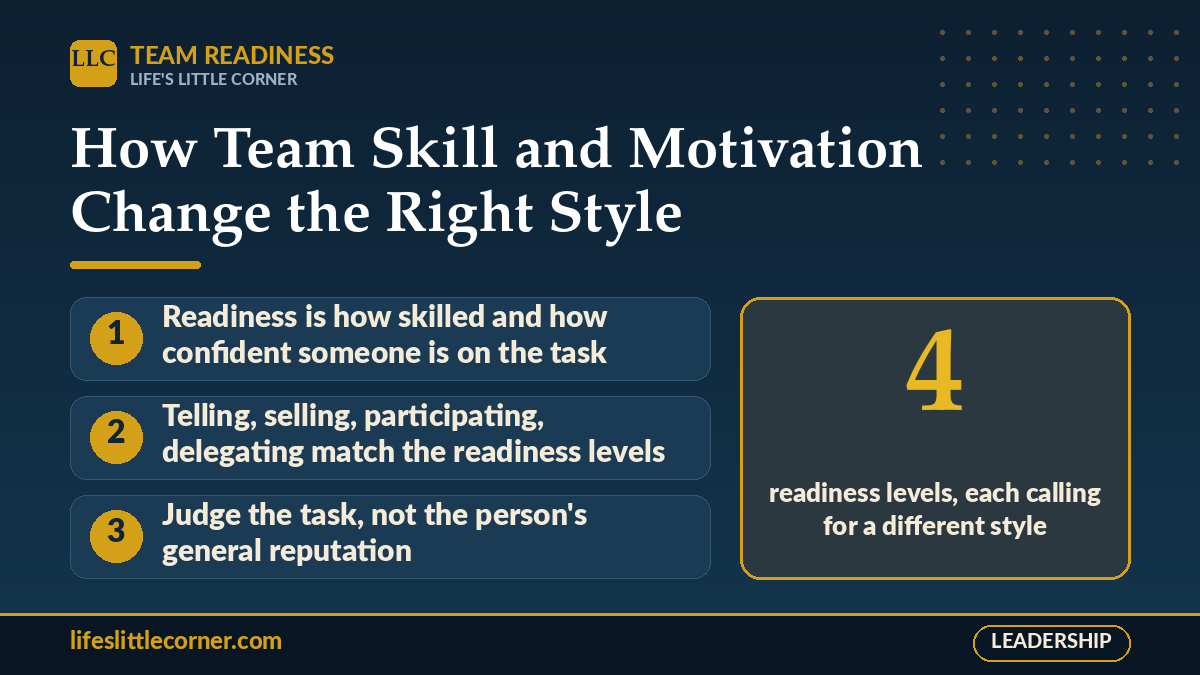
The single biggest factor in choosing a style is the other person’s readiness: how skilled they are at the task, and how confident and motivated they feel doing it. Hersey and Blanchard mapped this onto four readiness levels, and each one calls for a different style.
A person who is new to a task and still building basic skill needs a telling, or directing, style. That means clear, specific instructions, close supervision, and very little ambiguity. This is not disrespect. It is what someone actually needs when they do not yet know what “good” looks like.
As skill grows but confidence is still shaky, a selling, or coaching, style works better. The leader still explains the what and how, but now invites questions, explains the reasoning, and builds buy-in alongside competence. Someone at this stage does not need less direction yet. They need direction plus a real conversation about why it matters.
Once someone is skilled but their confidence wavers, a participating, or supporting, style fits. The leader steps back from giving instructions and instead shares decision-making, offers encouragement, and helps the person trust their own judgment. The skill gap has mostly closed. What is missing now is belief.
Finally, a highly skilled, highly confident person is ready for a delegating style: clear goals, real autonomy, and a leader who steps out of the way. Handing this person detailed instructions does not help them. It signals distrust and wastes their time. Related: What Leadership Style Do I Naturally Use? is a good next read if you want to figure out your own default before you start adjusting it.
One thing worth naming: readiness is not permanent, and it is not a single number attached to a person. Someone can be fully delegating-level on a task they have done for years and still need a telling-level style the first week they take on something genuinely new, like a first budget review or their first public presentation. Judge the task, not just the person’s general reputation on the team.
How the Task and the Stakes Change the Right Style
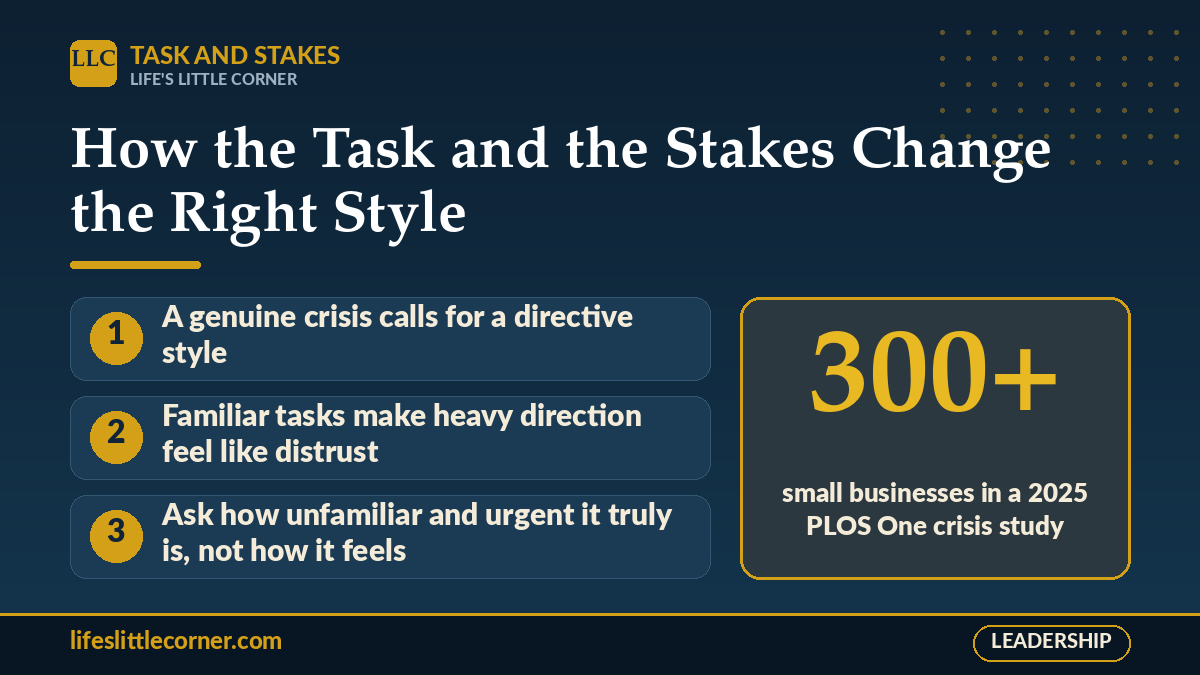
Readiness is not the only variable. The task itself, and how urgent or unfamiliar it is, changes what the best leadership style looks like too. A 2025 study published in PLOS One, covering more than 300 small and medium-sized businesses, found that both directive and transformational leadership predicted stronger organizational resilience during a genuine crisis, largely because directive leadership gave employees the psychological steadiness to keep functioning under real pressure.
That finding lines up with decades of crisis-leadership research: when a situation is unfamiliar, urgent, or genuinely dangerous, people want clear direction, not a long discussion. A wildfire evacuation, a data breach, a sudden safety incident. All of these call for a directive style, even from a leader who normally prefers a democratic, discussion-heavy approach.
The same research is equally clear about the flip side. Directive leadership stops helping, and starts hurting, once a task is familiar and the team already understands what to do. An experienced surgical team does not need step-by-step direction during a routine procedure. A veteran engineer does not need daily check-ins on a bug fix they have handled a hundred times before. In both cases, heavy direction reads as a lack of trust, and it slows people down instead of speeding them up.
The practical takeaway is a simple filter: ask how unfamiliar and how urgent the situation genuinely is, not how urgent it feels in the moment. A leader who treats every deadline like a five-alarm fire ends up directive by default, which burns out a capable team far faster than the actual crises ever would.
There is a real cost on the other side too. Staying democratic or hands-off during a genuine emergency, out of a wish to seem collaborative, can leave a team without the clear direction they actually need when seconds matter. The goal is not to pick a style you feel comfortable with and stick to it. It is to read the actual stakes honestly, even when that means stepping outside your usual comfort zone in either direction.
Want more leadership guides like this?
Get notified when Murshed’s upcoming Leadership book launches, plus practical posts on choosing the right style.
Get the free guide →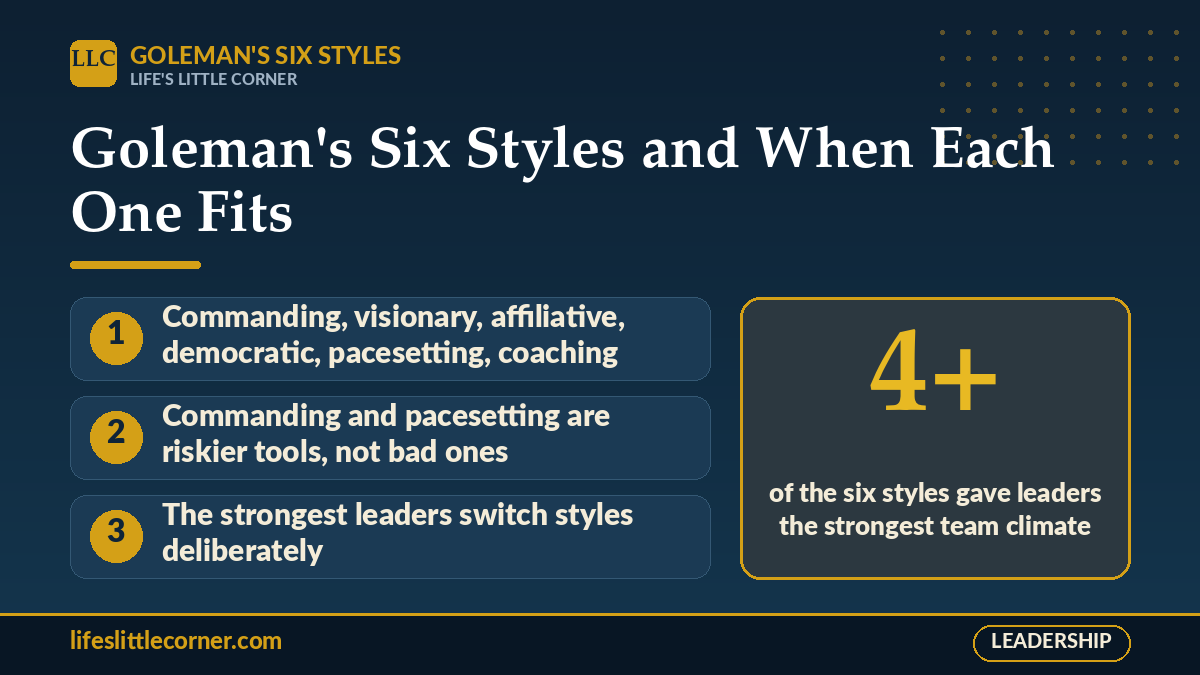
Goleman’s Six Styles and When Each One Fits
Psychologist Daniel Goleman ran a related but separate study, drawing on data from roughly 3,000 executives, and published the results in the Harvard Business Review classic Leadership That Gets Results. He identified six styles, each tied to a different piece of emotional intelligence: commanding, visionary, affiliative, democratic, pacesetting, and coaching.
Four of these six styles reliably build a positive team climate almost anywhere you use them. Visionary leaders mobilize people around a clear, shared direction. Affiliative leaders build trust and emotional connection, which matters most after conflict or during a hard stretch. Democratic leaders build genuine buy-in by involving people in real decisions. Coaching leaders invest in someone’s long-term growth, not just today’s task.
The other two styles are riskier tools, not bad ones. Commanding leadership, blunt orders with immediate compliance expected, genuinely works in a real emergency, but it corrodes trust fast if a leader defaults to it every day. Pacesetting, where the leader sets a punishing personal standard and expects everyone to match it, can produce short bursts of excellent output from an already-strong team, but it burns people out quickly and rarely builds anyone’s skill in the process.
Goleman’s own conclusion, confirmed again in a 2024 Harvard Business Review follow-up, is that the strongest leaders do not pick one favorite style. They carry several styles and switch between them deliberately, based on what the moment actually calls for. That flexibility is a skill, and like any skill, it can be built with practice. See also: Main Leadership Styles: 6 Types Every Leader Should Know for a fuller breakdown of each individual style.
Goleman’s data also points to a specific number worth remembering: leaders who could draw on four or more of the six styles created the strongest organizational climate, measured through things like flexibility, clarity of standards, and commitment. Leaders stuck using just one or two styles, no matter which ones, saw a measurably worse climate score. Range matters more than any single style being “right.”
How to Choose Your Style in the Moment
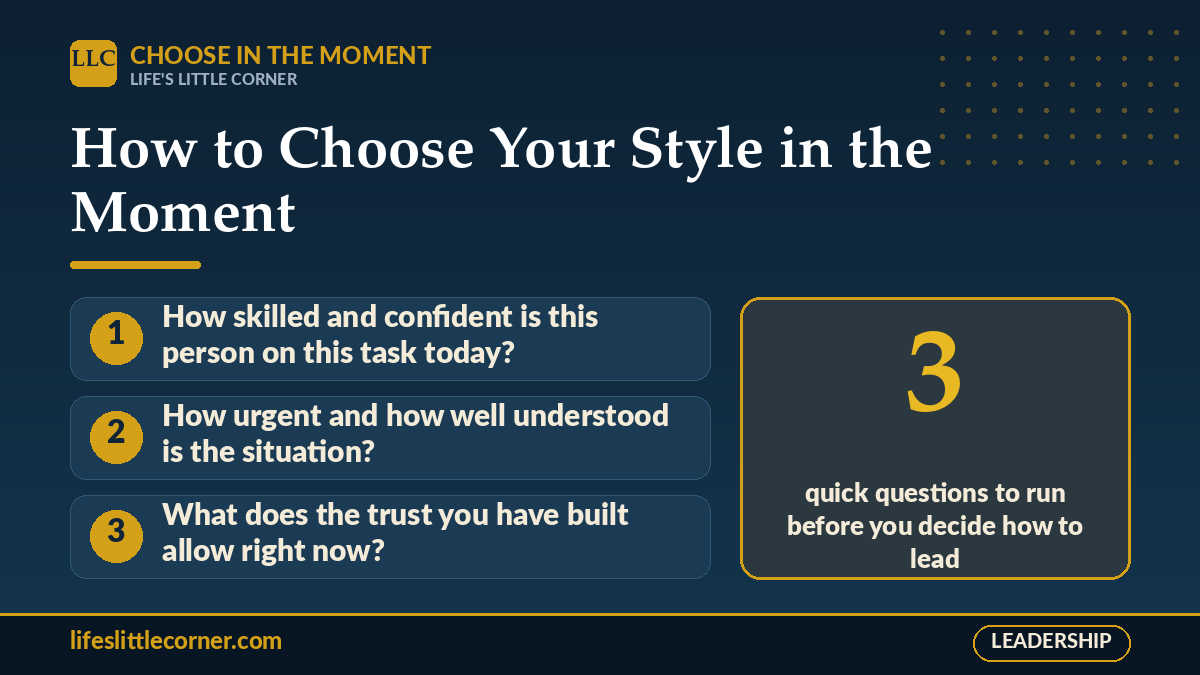
All this research is only useful if you can apply it fast, in the middle of a real workday, not just in hindsight. Try running three quick questions before you decide how to lead a specific moment.
First: how skilled and confident is this person on this exact task, right now? Not overall, not compared to their resume, just on this specific thing today. A strong performer tackling something brand new still needs more direction than their track record suggests.
Second: how urgent and how well-understood is the situation? A familiar task under normal time pressure rarely needs a directive style. A genuinely unfamiliar or fast-moving situation usually does, even with an experienced team.
Third: what does the trust you have already built with this person actually allow right now? Trust is not fixed. It grows with consistent follow-through and shrinks fast after a broken commitment, so this answer can change week to week, not just person to person. Related reading: What Makes Someone an Effective Leader? and The Most Important Leadership Skills both go deeper on the trust and communication piece.
None of this has to happen slowly. Most experienced leaders run through some version of these three questions in a few seconds, almost without noticing, the same way an experienced driver reads a changing road without narrating every decision out loud. New leaders tend to do it consciously and slowly at first, which is completely normal. The speed comes later. The judgment has to come first.
A quick gut-check if you are new to this: after any conversation where you gave direction, ask yourself honestly whether the other person left more capable and more confident than they walked in, or just more compliant. Compliance is easy to produce with almost any style. Genuine growth is the harder, better test of whether you actually picked the right one.
Want more posts like this one? Join the leadership list below and get notified as new guides go up.
The best leadership style is not a personality you were born with. It is a judgment call you make fresh, situation by situation, based on the person’s readiness, the task’s urgency, and the trust you have actually earned. Start by naming which style you default to without thinking, then practice deliberately reaching for a different one the next time the situation calls for it.